Showing posts with label Social. Show all posts

Sunday, 26 May 2013

Digital Storytelling as an Educational Tool


I recently stumbled upon some very, very interesting websites which featured some amazing digital stories, which got me thinking; how can I use this as a learning tool, if at all? This led to me stumbling upon an intriguing article written by Bernard Robin, which outlined the benefits of digital storytelling in the classroom. Robin describes digitally storytelling as creating a story utilising the technologies and capabilities a computer (or other technological device) has to offer, such as the incorporation of video, audio and even interactivity. Benefits of digital storytelling include their cheap production cost (once created, they can be distributed for free online rather than having to pay for printing) and the ability to create a very powerful story in a relatively small amount of time. Because of the ability to create these stories with software either standard on computers or with free downloadable software, anyone with access to a computer can easily create a simple digital story with just a few photos and some text. 


Robin also points out that the incorporation of audio and visual stimulation (through video/images) allows students to retain the information better, due to a reduced “cognitive overload” on the brain (Rudnicki et al, page 3). Robin includes images detailing the construction of a digital story, which can be found at the end of this post. Robin goes on to say that digital stories are effective at engaging students and promoting student discussion, and that the creation of digital stories can provide digital, global, technological, visual and information literacy skills, all of which are vital to living and working in the 21st century (Howell, 2012; Scardamalia et al, 2010). Creating digital stories may even give students experience in criticising the work of themselves and others, and may provide students with an environment rich in social learning and emotional intelligence (Robin, 2008). Robin paints digital stories as being quite versatile methods of teaching, and having found some very cool, interactive digital stories myself, I can see their potential uses in the classroom. Why have kids read Shakespeare when they can also hear, see and even interact with Shakespeare? Digital stories take the learning out of the boring, pen and paper learning space and place the learning environment in a digital setting, where students are much more comfortable (63% of the teenage population use the internet every day, and 73% use social media (1)). Digital stories could even be viewed on mobile devices, allowing students to access them anywhere, anytime, like at breakfast or before bed. 


References:


Digital Storytelling: A Powerful Technology Tool for the 21st Century Classroom – Bernard. R. Robin, 2008

New Assessment and Environments for Knowledge Building  - Scardamalia et al, 2010

Teaching With ICT, Jennifer Howell , Oxford University Press, South Melbourne, Victoria, 2012


 The Buzz Continues...The Diffusion of Digital Storytelling across disciplines and colleges at the University of Houston – A.Rudnicki, A.Cozart, A.Ganesh, C.Markello, S.Marsh, S.McNeil, H.Mullins, D.Smith, B.Robin


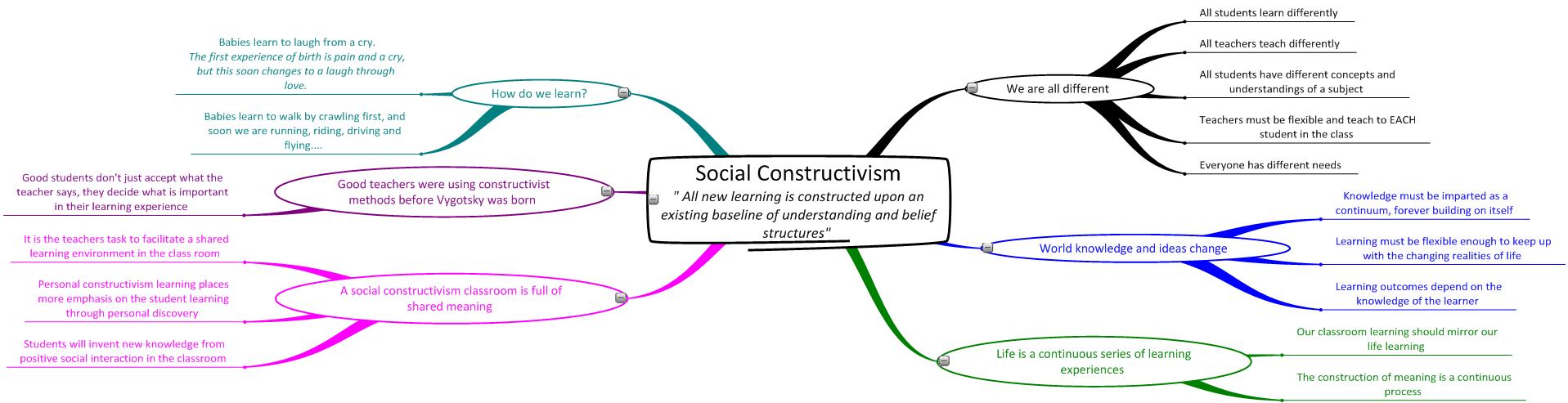
Social Constructivism

Social Constructivism is an interesting topic for me, for a few reasons. The first is its freedom in comparison to the traditional ‘sit down, shut up, listen’ teaching style I had for some of my classes throughout my schooling experience. Social Constructivism is comprised of three main aspects – student interaction, a more knowledgeable individual (usually a teacher) and for learning to occur in the Zone of Proximal Development (ZPD) (Howell, 2012). The ZPD can be defined as "the distance between the actual developmental level as determined by independent problem solving and the level of potential development as determined through problem solving under adult guidance, or in collaboration with more capable peers" (Vygotsky, 1978, p86, referenced in Mcleod, 2012). For students to be kept in the ZPD, the tasks assigned to them should be very difficult to complete when attempted individually, but much simpler when performed with an appropriately minimal amount of guidance. The theory (as developed by Lev Vygotsky) then goes to say that once the previously difficult task has been completed with an appropriately trivial amount of guidance, it will be quite easy to complete in the future. I find this concept very interesting, as it is essentially how I learned senior mathematics – my teacher which would provide very subtle hints to difficult maths problems which allowed me and my classmates to quickly complete to given task while we interacted with each other allowing steps we may not have been able to complete individually to be worked through and better understood. All this occurred without a teacher handing out detentions for communicating with friends, which made the lessons more interesting as we were still socialising and interacting as we would have outside the classroom (even if were talking about math rather than sports). The fantastic thing about social construction is its ability to be applied to a wide variety of content, and the fact it can be utilised in many ways; McLeod (2010) provides a fantastic example of social constructivism in learning to play tennis, I learnt basic calculus through social constructivism and tasks such as learning computer skills or producing digital stories (Howell, 2012) can also be exploited by social constructivism. In previous posts I talked about the increasing use of technology in everyday life and the necessity to introduce such technology into the classroom. Howell lists many aspects of the digital world as being easily taught through the use of social constructivism. Social constructivism doesn’t even have to occur in the classroom – with the integration of modern, everyday technology, students can access their ‘more knowledgeable other’ via text message or a social networking site, allowing them to complete difficult tasks at home, in their own time. Students experiencing trouble embedding a Youtube link in their blog about cell division? They can simply contact a friend or teacher for that extra bit of assistance to help them embed the video and finish the task, without having been babied the whole way.


References:
Teaching With ICT -  Jennifer Howell, Oxford University Press, South Melbourne, Victoria, 2012

Zone of Proximal Development – Saul McLeod, 2012


Image; http://sabb46.edublogs.org/files/2011/01/contructivistcartoon-2d5vhhy.png